

Peregrinus

1984 - Present
Description
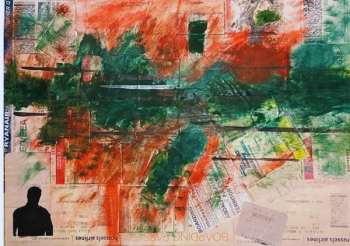
Peregrinus in Latin means “foreigner,” and this work aims to shed light on the artist himself as a foreigner. The piece reflects on identity, exile, borders, displacement, and the fragility of movement. It is based on the artist’s own archive of boarding passes from a specific period during which he was not allowed to travel outside Europe without a visa. These boarding passes form the collage of the work.
Across the collage, there are both deep and shallow strokes of various shades of green, moving from left to right, cutting through the piece and symbolizing identity. This green reflects both the color of the olive tree and themes of militarization and occupation. The green cuts also symbolize boundaries and lifelines, while the red streaks suggest wounds and the turbulence of the foreigner. The black straight lines represent the bodily traces of displacement and movement, fragmented and disconnected.
In the lower corner, a solitary black silhouette emerges—faceless, anonymous, a shadow of the traveler. This figure embodies the Peregrinus: the displaced person whose identity is reduced to documents, codes, and checkpoints.
Artist Notes
The collage for this work was created in 2018 and left abandoned until 2025. It reflects a moment when I was trying to return to art. The piece documents a period of my life in which statelessness, the struggle for identity, and fragmentation were overwhelming. The work goes beyond personal memory, offering a Palestinian reflection on exile, borders, and the human cost of displacement. I intentionally made the composition chaotic, as it mirrors the inner chaos I experienced—uncertainty about where I was heading or where I could settle. The work consists of fragments of boarding passes that allowed me to move, leave, and return to places where I had no roots. For me, these papers were never neutral; they are politicized and deeply embedded in institutions that define a person not only by citizenship, but beyond that, by their very existence. By assembling these fragments and marking them with red and green strokes, I sought to emphasize the contrast between memory and erasure. Green represents the olive tree and identity; red signifies wounds and suffering that leave endless scars; and black lines trace the unknown. The faceless silhouette represents the Peregrinus—a figure who could be anyone. Through this work, I search for memories, places, exile, and loss.
Preservation Notes
Freshly painted 20 years old tickets and boarding passes throughout the borders of the Global South, the Mid East The EU


